We remark that you can often substitute \(\infty\) into the antiderivative and subtract: \(\displaystyle \int_1^\infty dx/x^2 = (-1/x)|_1^\infty = 0 - (1) = 1\text{.}\) If the value of \(-1/(\infty)\) were not obvious, you would need limits.
What is \(\displaystyle \int_{-\infty}^\infty \frac{x}{x^2 + 1}\text{?}\)
Choosing \(c=0\text{,}\) we see it is the sum of two one-sided infinite integrals \(\int_0^\infty x/(x^2+1) \, dx + \int_{-\infty}^0 x/(x^2+1) \, dx\text{.}\) Going back to the definition replaces each one-sided infinite integral by a limit:
It looks as if this limit is coing to come out to be zero because \(x/(x^2 + 1)\) is an odd function. Integrating from \(-M\) to \(M\) will produce exactly zero, therefore
The answer to the first question is, pick \(c\) to be anything, you’ll always get the same answer. This is important because otherwise, what we wrote isn’t really a definition. The reason the integral does not depend on \(c\) is that if one changes \(c\) from, say, 3 to 4, then the first of the two integrals loses a piece: \(\int_3^4
f(x) \, dx\text{.}\) But the second integral gains this same piece, so the sum is unchanged. This is true even if one or both pieces is infinite. Adding or subtracting the finite quantity \(\int_3^4 f(x) \, dx\) won’t change that.
The answer to the second question is yes, sometimes you can be more specific. The one-sided integral to infinity is a limit. Cases where a finite limit does not exist can be resolved into limits of \(\infty\) or \(-\infty\text{,}\) along with the remaining cases where no limit exists even allowing for infinite limits. Because integrals over the whole real line are sums of one-sided (possibly infinite) limits, the rules for infinity from Sections \ref{ss:variations} and \ref{ss:LH} can be applied. In other words, integrals over the whole real line are the sum of two one-sided limits; we can add real numbers and \(\pm \infty\) according to the rules in Definition 2.33: \(\infty + \infty = \infty\) (and analogously with \(-\infty\)), \(\infty + a = \infty\) when \(a\) is real (and analogously with \(-\infty\)), \(\infty - \infty = UND\text{,}\)\(UND + {\rm anything } = UND\text{,}\) and so on.
On one hand, \(\int_{-M}^M f(x) \, dx\) is always zero, because the postive and negative parts exactly cancel. On the other hand, \(\int_M^\infty f(x) \, dx\) and \(\int_{-\infty}^M f(x) \, dx\) are always undefined. Do we want the answer for the whole integral \(\int_{-\infty}^\infty f(x) \, dx\) to be undefined or zero? There is no intrinsically correct choice here but it is a lot safer to have it undefined. If it has a value, one could make a case for values other than zero by centering the integral somewhere else, as in the following exercise.
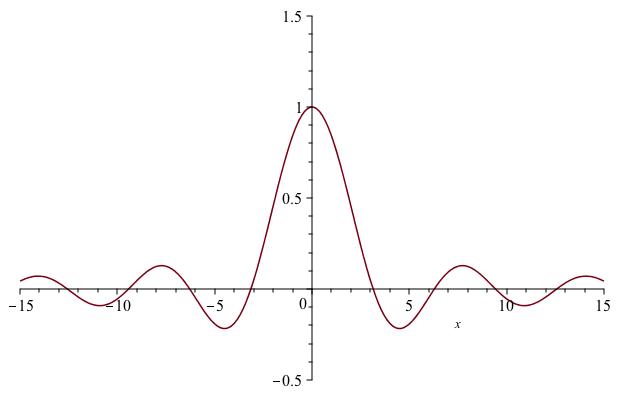
The function \(\sin(x) / x\) is not defined at \(x=0\) but you might recall it does have a limit at 0, namely \(\displaystyle\lim_{x \to 0} \sin(x) / x = 1\text{.}\) Therefore the function
\begin{equation*}
\operatorname{sinc} (x) := \begin{cases} \sin(x) / x & x \neq 0 \\ 1 & x=0 \end{cases}
\end{equation*}
is a continuous function on the whole real line. Its graph is shown in Figure 12.7.
To write down a limit that defines this integral, we first choose any \(c\text{.}\) Choosing \(c=0\) makes things symmetric. The integral is then defined as the sum of two integrals, \(\int_{-\infty}^0 \operatorname{sinc}(x) \, dx +
\int_0^{\infty} \operatorname{sinc}(x) \, dx\text{.}\) Going back to the definition of one-sided integrals as limits, this sum of integrals is equal to
It is not obvious whether these limits exist. One thing is easy to discern: because \(\operatorname{sinc}\) is an even function, the two limits have the same value (whether finite or not). We can safely say: