We have seen integrals interpreted as areas and volumes, totals and averages, moments, and probabilities. One more use of an integral is to estimate a sum. In a way this is the reverse of the definition, which tells you that an integral is estimated by Riemann sums, in fact is a limit of such sums. Going the other way, if we have a sum, we can write an integral for which it is a Riemann sum. We may then expect the integral to be a good approximation for the sum. This will be easier when we know how to compute more integrals, but there are plenty we can already compute. We illustrate with a long example. It starts with the fact that the derivative of \(\ln x\) is \(1/x\text{.}\) This means that an anti-derivative of \(1/x\) is \(\ln x\text{.}\)
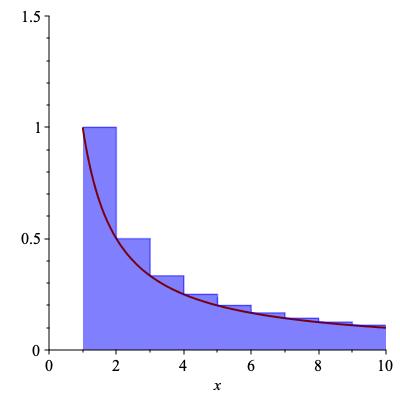
Problem: estimate the \(100^{th}\) harmonic number \(1 + 1/2 + 1/3 + \cdots + 1/100\text{.}\) To solve this, we may as well estimate \(H_n := \displaystyle\sum_{k=1}^n 1/k\) for any positive integer \(n\text{.}\) Summing \(1/n\) looks a lot like integrating \(1/x\text{.}\) In fact, suppose we write a Riemann sum for \(\displaystyle\int_1^n 1/x \, dx\) that has precisely \(n-1\) rectangles. Then the intervals \(I_k\) are just the intervals \([1,2], [2,3], \ldots , [n-1,n]\text{.}\) Even better, we can make areas of the rectangles be exactly the same as in the sum. We just need to use the upper Riemann sum: \(1 + 1/2 + \cdots + 1/(n-1)\text{;}\) see the left-hand side of Figure 10.30 for a picture of this when \(n=9\text{.}\)
Figure10.30.
representing the harmonic sum as upper and lower Riemann sums
Figure 10.30 shows that \(H_{n-1}\) is an upper Riemann sum for \(\displaystyle\int_1^n 1/x \, dx\text{.}\) It turns out (see Proposition 10.27 below) that this integral has a nice formula:
\begin{equation*}
\displaystyle\int_1^n \frac{1}{x} \, dx = \ln n - \ln 1 = \ln n \, .
\end{equation*}
Therefore, we have shown the bound \(H_{n-1} \geq \ln n\text{.}\) In particular, choosing \(n = 101\text{,}\) we see that \(H_{100} \geq \ln 101 \approx 4.615\text{.}\)
Is this an upper bound or a lower bound? It depends on your point of view. If we were trying to figure out the integral up to 100, \(H_{100}\) would be an upper bound on the value. But in this case we know the integral and are trying to estimate \(H_{100}\text{.}\) The integral provides a lower bound, in this case \(4.615\text{.}\)
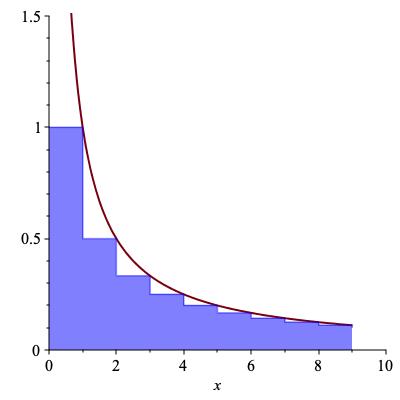
What about an upper bound on \(H_{100}\text{.}\) The obvious thing is to see if we can make the same sum be a lower Riemann sum. Watch what happens when you try to do this. Take the graph, shift all the rectangles one unit left, and voilà! (See the right-hand side of Figure 10.30.) This shows that \(H_{100}\) is a lower Riemann sum for a slightly different integral, namely \(\displaystyle\int_0^{100} \frac{1}{x} \, dx\text{.}\) Alas, this is not an integral we can do because \(1 / x\) is not continuous at \(x=0\text{.}\) In fact, when we study improper integrals, we will see this evaluates to \(+ \infty\text{.}\) Sure, we get the upper bound \(H_{100} \leq \infty\text{,}\) but that is hardly useful. All is not lost, however, if we use some common sense. The same picture shows that an upper bound for the harmonic sum starting at 2 instead of 1 is
So, adding back the 1, we see that \(H_{100} \leq 1 + \ln 100 \approx 5.605.\) This is about as good as we can do with the techniques we have so far: \(4.615 \leq H_{100} \leq 5.605\text{.}\) For the record, \(H_{100} \approx 5.1874\text{.}\)