It helps to think about all such problems in units. Although inches are bigger than centimeters by a factor of \(2.54 \text{,}\) numbers giving lengths in inches are less than numbers giving lengths in centimeters by exactly this same factor. Writing this in units prevents you from making a mistake. The quantity 1 inch is the same as the quantity 2.54 centimeters, so their quotient in either order is the number 1 (unitless). We can multiply by 1 without changing something. Thus,
Taking a power raises the units to that power. For example, if \(x \) is in units of length, say centimeters, then \(3 x^2 \) will have units of area, in this case square centimeters. Most functions other than powers require unitless quantites for their input. For example, in a formula \(y = e^{***} \) the quantity *** must be unitless. The same is true of logarithms and trig functions: their arguments are always unitless.
Often what we can easily tell about a function is that it is proportional to some combination of other quantities, where the constant of proportionality may or may not be known, or may vary from one version of the problem to another. Constants of proportionality have units, which may be computed from the fact that both sides of an equation must have the same units.
If the monetization of a social networking app is proportional to the square of the number of subscribers (this representing perhaps the amount of messaging going on) then one might write \(M = k N^2 \) where \(M \) is monetization, \(N \) is number of subscribers and \(k \) is the constant of proportionality. You should always give units for such constants. They can be deduced from the units of everything else. The units of \(N \) are people and the units of \(M \) are dollars, so \(k \) is in dollars per square person. You can write the constant as \(k \; \frac{\$}{{\rm person}^2} \text{.}\)
To say \(A \) is inversely proportional to \(B \) means that \(A \) is proportional to \(1/B \text{.}\) If a quantity \(A \) is proportional to both quantities \(B \) and \(C \text{,}\) which can vary independently, then \(A \) must be proportional to \(B \cdot C \text{,}\) so \(A = k \; B \, C \) for some constant of proportionality, \(k \text{.}\)
If the expected profit on a home sale is proportional to the assessed value of the home and inversely proportional to the number of days it has been on the market, we could capture that relation as \(P = k V / T \) where \(P \) is profit in dollars, \(V \) is assessed price in dollars, \(T \) is number of days on the market, and \(k \) is a constant of proportionality.
Sometimes in mathematical modeling, an equation represents an empirical law, which is a rough fit to some function. For example, energy loss due to the nature of alternating current is said to be inversely proportional to the \(0.6 \) power of the frequency, but this is simply the best fit to data, not due to electromagnetic theory. In that case, units will not make sense. For example, if it is observed that the blood volume of small mammals is roughly proportional to the 2.65 power of the mammal’s length, sensible units will not be assignable to the proportionality constant \(k \) in the formula \(BV = k L^{2.65} \text{.}\) In this case we just have to live with the fact that \(k \) has units involving fractional powers of length that won’t make much sense outside of this context.
An important point when writing up your work: You don’t just write \(M = k N^2 \) without stating the interpretations of the three variables. Also, there would not usually be a \(:= \) here, because you are not defining the function \(M(N) := k N^2 \) as much as you are saying that two observed quantities \(M \) and \(N \) vary together in a way that satisfies the equation \(M = k N^2 \text{.}\) There isn’t a clear line here, but the style of the definition can be important in conveying to the reader what’s going on.
The present value under constant discounting is given by \(V(t) = V_0 e^{-\alpha t} \) where \(V_0 \) is the initial value and \(\alpha \) is the discount rate. What are the units of \(\alpha \text{?}\) They have to be inverse time units because \(\alpha t \) must be unitless. A typical discount rate is 2% per year. You could say that as "\(0.02 \) inverse years." We hope that by the end of the semester, the notion of an inverse year is somewhat intuitive.
Often quantities are measured as proportions. For example, the proportional increase in sales is the change is sales divided by sales. In an equation: the proportional increase in \(S \) is \(\Delta S / S \text{.}\) Here, \(\Delta S \) is the difference between the new and old values of \(S \text{.}\) You can subtract because both have the same units (sales), so \(\Delta S \) has units of sales as well. That makes the proportional increase unitless. In fact proportions are always unitless.
Percentage increases are always unitless. In fact they are proportional increases multiplied by 100. Thus if the proportional increase is \(0.183 \text{,}\) the percentage increase is \(18.3\% \text{.}\) In this class we aren’t going to be picky about proportion versus percentage. If you say the percentage increase is \(0.183 \) or the proportional change is \(18.3\%\text{,}\) everyone will know exactly what you mean. But you may as well be precise.
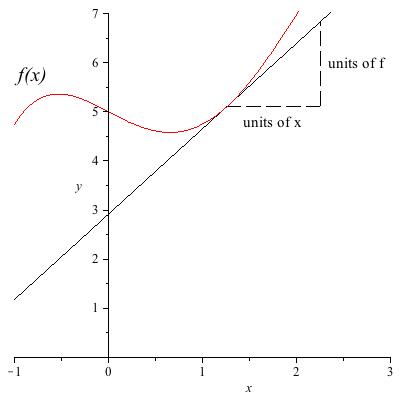
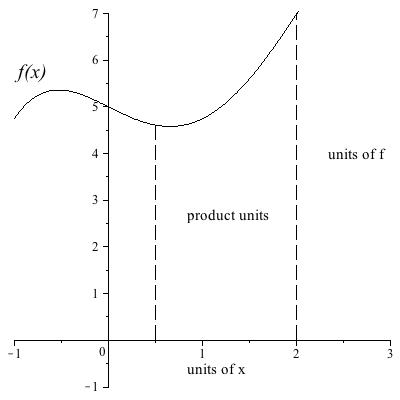
Units behave predictably under differentiation and integration as well. We will refer back to this when we define the relevant concepts, but you may as well see a preview now. The derivative \((d/dx) f \) has units of \(f \) divided by units of \(x \text{.}\) You can see this easily on the graph in Figure 1.5 because the derivative is a limit of rise over run, where rise has units of \(f \) and run has units of \(x \text{.}\) The integral \(\displaystyle\int f(x) \, dx \) has units of \(f \) times units of \(x \text{.}\) Again you can see it from a picture (Figure 1.6), because the integral is an area under a graph where the \(y\)-axis has units of \(f \) and the \(x\)-axis has units of, well, \(x \text{.}\)