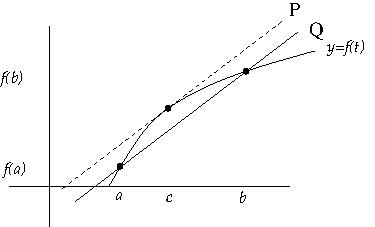
It’s easy to define your average speed for a trip: take the number of miles, divide by the number of hours, and there’s your average speed in miles per hour. If you journey at constant speed, then that’s also your speed at every moment of the trip. Most of us do not travel at constant speed. What is your speed then? How do you define it? How do you measure it? How do you compute it if you know some equation for your position at time \(t\text{?}\)
The concept of instantaneous speed is subtle. It is what spurred the invention of calculus over a few decades near the year 1700. It is a very general notion. Average speed is distance traveled per total time. Instantaneous speed is some instantaneous version.
The figure shows distance traveled \((f(t))\) against time \((t)\text{.}\) The slope of line \(P\) can be interpreted as what in terms of speed? What about the slope of line \(Q\text{?}\)
If you replace "distance traveled" by "production price" and "time elapsed" by "units produced" you get the notions of average production cost per unit; marginal cost per unit is the instantaneous version. The list of applications is endless. Mathematically, they are all the same: if \(f\) is a function and \(x_0\) and \(x_1\) are starting and ending arguments for \(f\text{,}\) then the average change in \(f\) over the interval is \((f(x_1) - f(x_0)) / (x_1 - x_0)\text{;}\) the instantaneous rate of change of \(f\)with respect to \(x\) is called the derivative of \(f\) with respect to \(x\) and denoted \(f'(x)\text{.}\)
In this section we will see how to understand \(f'\) both physically and mathematically. We will continue to use instantaneous speed as a running example of the physical concept, and instantaneous rate of change of \(f(x)\) with respect to \(x\) as the corresponding mathematical concept.
We can take the slope of the function \(f\) at any point. Taking it at \(x\) gives a value we call \(f'(x)\text{.}\) That means that \(f'\) is a function: give it an argument \(x\) and it will produce the slope of \(f\) at that point. It will be helpful to keep in mind that the derivative operator takes as input functions \(f\) and produces as output their derivatives \(f'\text{.}\) Operator is a fancy word for a function whose input and output are functions rather than numbers. Taking derivatives is a linear operator. This is captured in Proposition 4.1 through Proposition 4.3 below.
Suppose you replace “distance traveled” by “elevation of trail” and “time elapsed” by “distance hiked”. What would be the physical interpretation of the instantaneous rate?