Unit 1 Where should I put my ladder?
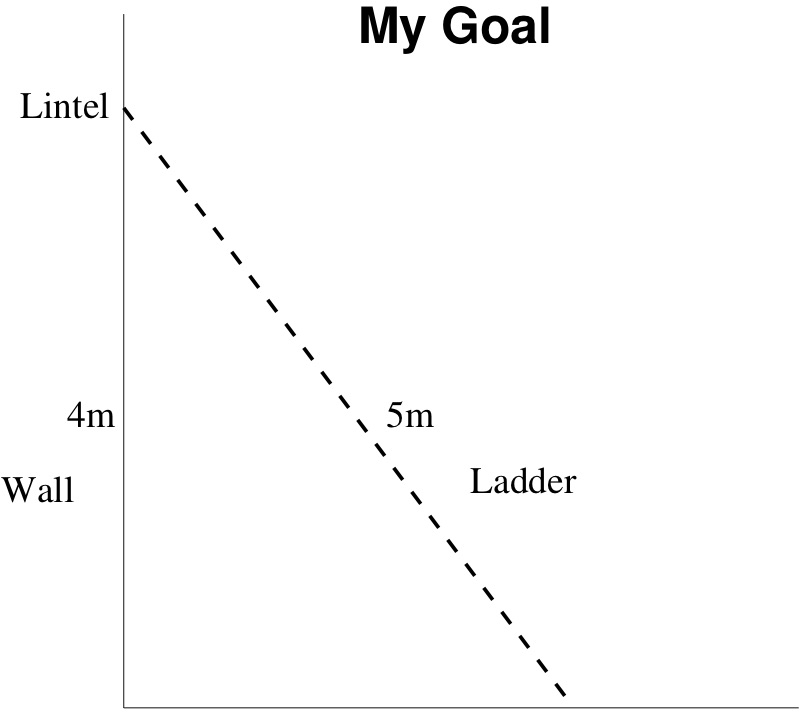
I am hanging wind chimes on my balcony using a ladder 5 meters long. On the highest safe step, my shoulders will be exactly at the top of the ladder, which I need to be at the height of the balcony rail, 4 meters above the ground. Every time I reposition the ladder I scratch the paint, so I’d rather not move it too many times. I need to get my shoulders within a couple of centimeters of the right height in order to drive a nail into the lintel. Where should I put the base of the ladder? The Pythagorean theorem tells me the it should be 3 meters from the wall; see Figure 1.2
Unfortunately, I didn’t measure right, maybe because of the bulge at the bottom of the balcony. I am 20 cm too low. Now what? Solution: Let \(h\) be the function representing the height of the ladder as a function of the position of the base, in other words, \(h(x)\) is the height of the ladder on the wall (in meters) when the base is \(x\) meters from the wall. By the Pythagorean Theorem, \(h(x) = \sqrt{25 - x^2}\text{.}\)
The height I am trying to reach is shown in Figure 1.3. which has \(x=3\) and \(h(x) = 4\text{.}\) Instead I hit some other point \(z\) with \(h(z) = 3.8\text{.}\) Clearly \(z\) is too far from the wall. How far do I need to scoot the ladder toward the wall? As you can see in Figure 1.3, due to the balcony and the hedge, it was not feasible to measure either the height of the lintel or the distance I placed the foot of the ladder more accurately.
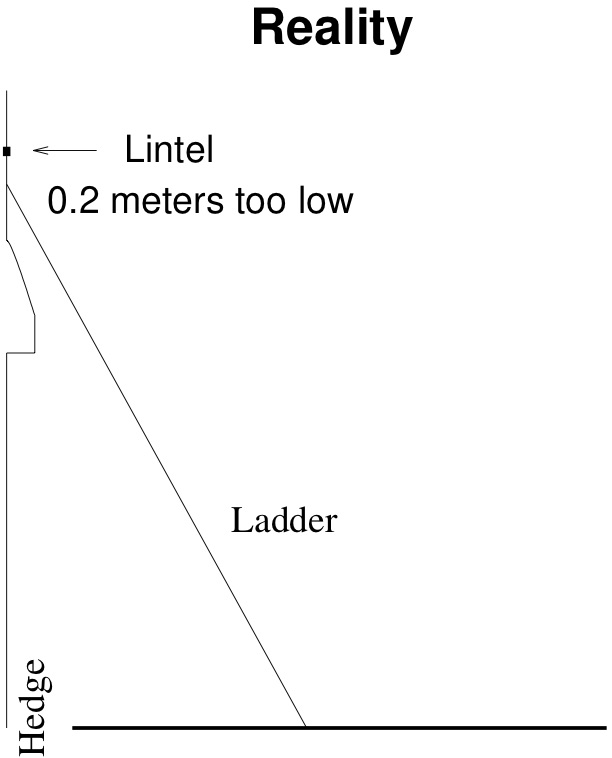
Figure 1.4 shows the graph of \(h\) and a tangent line to the graph of \(h\) at the point \((3,4)\text{.}\) The tangent line is a very good approximation to the graph near \((3,4)\text{.}\) For values of \(x\) between perhaps 2.6 and 3.4, the line is still visually indistinguishable form the graph.
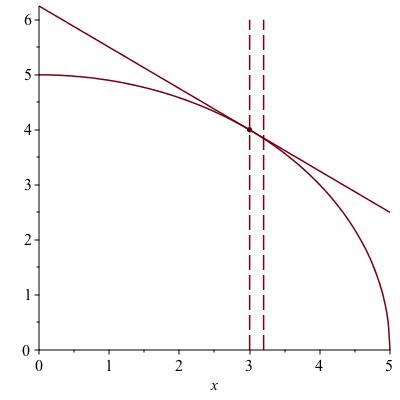
If we know the slope of this line, \(m\text{,}\) we can write the equation of the line: \((y-4) = m (x-3)\text{.}\) Because \(h(x)\) is very nearly equal to this \(y\) (because the curve nearly coincides with the line), we can write \(h(x) \approx 4 + m(x-3)\text{.}\) The wiggly equal sign is not a formal mathematical symbol. Here, it means the two will be close, but has no guarantee of how close, and furthermore, it is only supposed to be close when \(x\) is close to \(3\text{.}\) This is called an estimate. Shortly, we will talk about bounds: estimates that do come with guarantees.
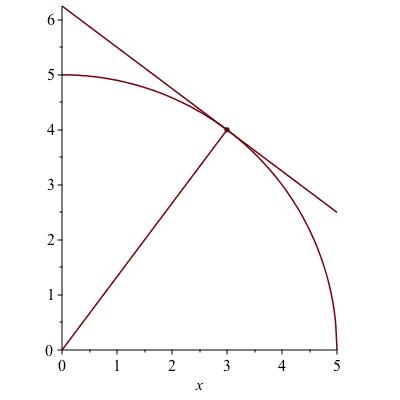
What is the slope of this line? The graph is a quarter-circle. Recall from geometry that any tangent to a circle makes a right angle with the radius. The slope of the radius from \((0,0)\) to \((3,4)\) is \(s = 4/3\text{.}\) The slope of any line making a right angle with this is the negative reciprocal \(-1/s = - 3/4\text{.}\) In other words, the slope of the tangent line is \(-3/4\text{.}\)
Checkpoint 1.
The reason we chose this particular example to demonstrate the tangent line approximation is that we could compute the slope with high school geometry. With calculus, we’ll be able to find the slope of a tanget line to just about any function we can think of. In fact the word calculus when it was invented meant literally "a method of computing".

