Unit 3 Concavity
A more subtle bound come when \(f\) is known to be concave upward or downward in some region. By definition, a concave upward function lies below its chords and a concave downward function lies above its chords.
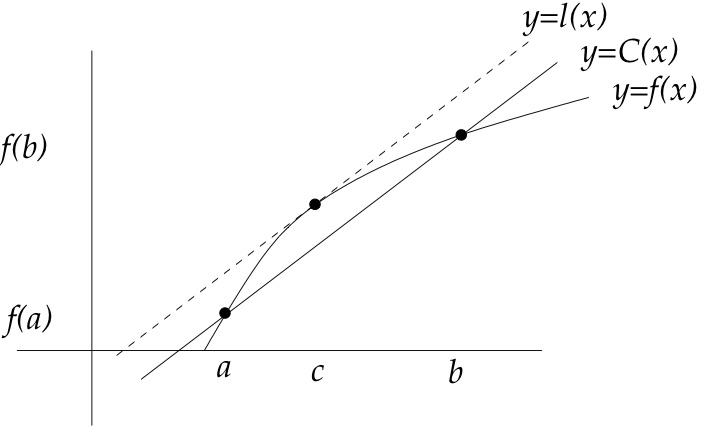
Figure 3.8 shows a function \(f(x)\) which is concave down. As long as \(x\) is in the interval \([a,b]\text{,}\) we are guaranteed to have \(C(x) \leq f(x)\text{.}\) On the other hand, when \(f'' \lt 0\) on an interval, the function always lies below the tangent line. Therefore \(L(x)\) is an upper bound for \(f(x)\) when \(x \in [a,b]\) no matter which point \(c \in [a,b]\) at which we choose to take the linear approximation.
In the ladder example, we were lucky that the graph was a familiar geometric shape, a quarter circle, which we know to be convex. We are able to conclude that the tangent line remains above the graph because we know geometrically that the tangent line to a circle touches the circle at one point and otherwise remains outside the circle. Calculus will give us a far more general way to determine concavity.

