The series in Example 9.4 sums to a rational number. According to Excel it is equal to \(23763863/4084080\text{.}\) There isn’t any really nice formula for this sum in terms of the values 5 and 19 and the function \(n \mapsto 3/(n-2)\text{.}\) In fact most series don’t have nice summation formulas. Arithmetic and geometric series are exceptions. Because they are common and the formulas are simple and useful, we include them in this course.
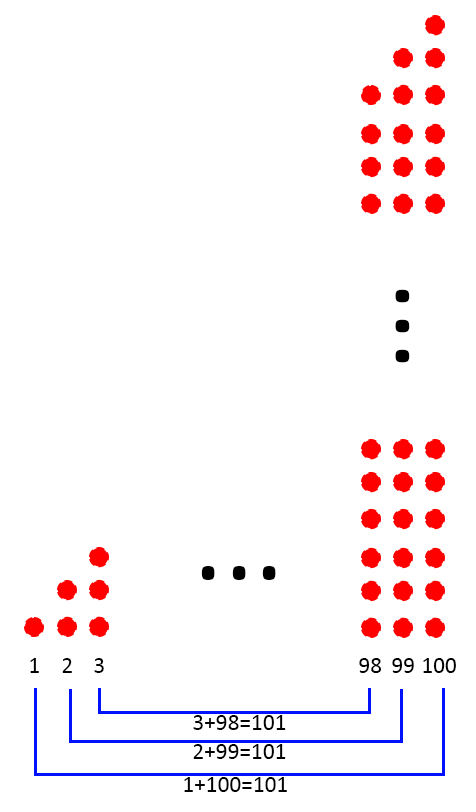
Here’s an example of how to sum an arithmetic series, which generalizes easily to summing any arithmetic series. This particular example is a well known piece of mathematical folklore (google "Gauss child sum").
Pair the numbers starting from both ends: 1 pairs with 100, 2 pairs with 99, and so forth, ending at 50 paired with 51. There are 50 pairs each summing to 101, so the sum is \(50 \times 101 = 5050\text{.}\)
Evaluate \({\displaystyle\sum_{n=13}^{29} n}\text{.}\) There are 17 terms and the average is 21, which can be computed by averaging the first and last terms: \((13+29)/2 = 21\text{.}\) Therefore, the sum is equal to \(17 \times 21 = 357\text{.}\)
Suppose we want to sum the arithmetic series \(\displaystyle\sum_{k=\ell}^u a + kd\text{.}\) We have already seen that every arithmetic series can be written this way, so this exercise solves the problem of summing every arithmetic series (yet is easy enough to put in an exercise!).
This is more general than our usual exercise. You might find it easier to try a few examples with numbers (i.e., try \(L=5,U=12,a=1\text{;}\) then try \(L=3,U=9,a=2\)) before doing the exercise with algebraic expressions.
The standard trick for summing geometric series is to notice that the sum and \(r\) times the sum are very similar. It is easiest to explain with an example.
Evaluate \({\displaystyle\sum_{n=1}^{10} 7 \cdot 4^{n-1}}\text{.}\) To do this we let \(S\) denote the value of the sum. We then evaluate \(S - 4S\) (because \(r=4\)). I have written this out so you can see the cancellation better.
The chance that it takes precisely \(n\) rolls of a standard die in order to roll your first 6 is \((5/6)^{n-1} (1/6)\text{.}\) Sum 10 terms of a geometric series to find the chance that you first see a 6 by the time of your tenth roll. Enter your answer as a decimal to three places.
Letting \(S\) denote the sum we have \(S - rS = A - A r^M\) and therefore
\begin{equation*}
S = A \, \frac{1 - r^M}{1-r} \, .
\end{equation*}
When \(A\) and \(r\) are positive, all the terms are positive, hence the sum is positive as well. When \(r < 1\) this is very evident from the formula. When \(r > 1\) it is true as well, but easier to see multiplying top and bottom by \(-1\) so as to get \(A (r^M-1) / (r-1)\text{.}\) When \(r=1\) this quotient is undefined, however the sum is very easy: \(M\) copies of \(A\) sum to \(A \cdot M\text{.}\)