A function \(f \) is said to be continuous at the value \(a \) if the limit exists and is equal to the function value, in other words, if \(\displaystyle\lim_{x \to a} f(x) = f(a) \text{.}\)
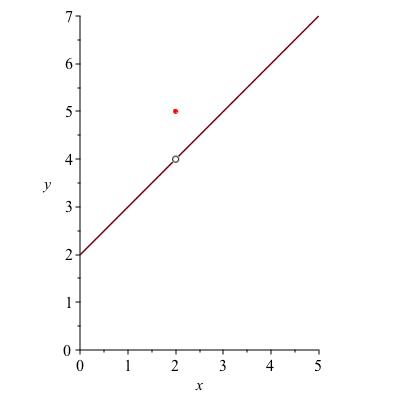
Intuitively, this means the limit at \(a \) exists and there is no hole: the function is actually defined at \(a \) and wasn’t given some weird other value. To illustrate what we mean, consider this picture of a function that is discontinuous at \(x=2 \) even though \(\displaystyle\lim_{x \to 2}
f(x) \) exists and so does \(f(2) \text{,}\) because the values don’t agree.
A function is said to be continuous on an closed interval \([a,b] \) if it is defined and continuous at every point of \([a,b] \text{,}\) with only one-sided contintuity required at \(a^+ \) and \(b^- \text{.}\)
Which of the basic trig functions \(\sin \text{,}\)\(\cos\) and \(\tan\) are continuous on \((0, 2\pi)\text{?}\) You don’t need to prove your answer, just to have an intuitive justification in mind.
Before going on to use the notion of continuity to help us compute limits, we will state one famous result which will seem either stupid and obvious or deep and tricky.
Let \(f \) be a continuous function defined on the closed interval \([a,b]\) and suppose that \(y \) is any value between the values \(f(a) \) and \(f(b) \text{.}\) Then there is some number \(c \) in the interval \([a,b] \) satisfying \(f(c) = y \text{.}\)
This says, basically, a continuous function can’t get from one value to another without hitting everything in between. The theorem is most often used when there is a number we can only define this way. For example, let \(f(x) := e^x / x \text{,}\) which is an increasing function on the half-line \([1,\infty) \text{.}\) We want to say "let \(c \) be the value for which \(f(c) = 3 \text{.}\)" How do we know there is one? Well, \(f(1) = e \text{,}\) which is less than 3, and \(f(3) \approx 6.695 \) which is greater than 3. So there must be an argument between 1 and 3 where \(f \) takes value 3. There can be only one because \(f \) is strictly increasing (you can prove after another two sections).