Unit 0.4 Graphing

As you already know, points in the plane can be labeled by ordered pairs of real numbers. As you also already know, the graph of a function \(f\) is the set points in the plane corresponding to the ordered pairs \(\{ (x , f(x)) : x \in \text{domain of } f \}\text{.}\)
Often the graph of a function is a continuous curve, and can be quickly drawn, conveying essential information about \(f\) to the eye much more efficiently than if the reader had to wade through equations or set notation.
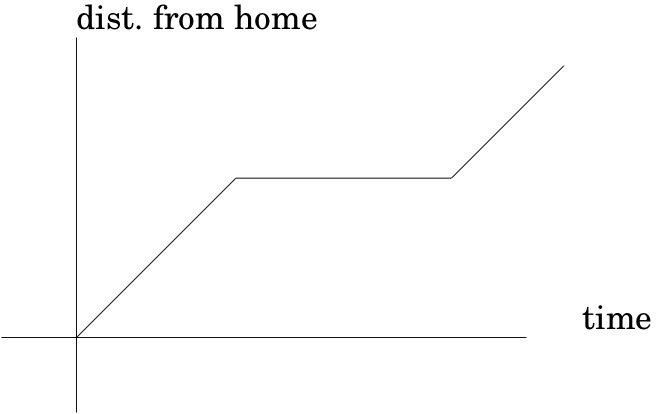
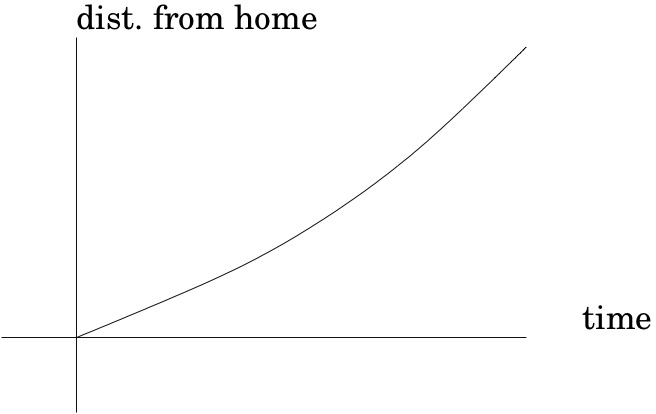
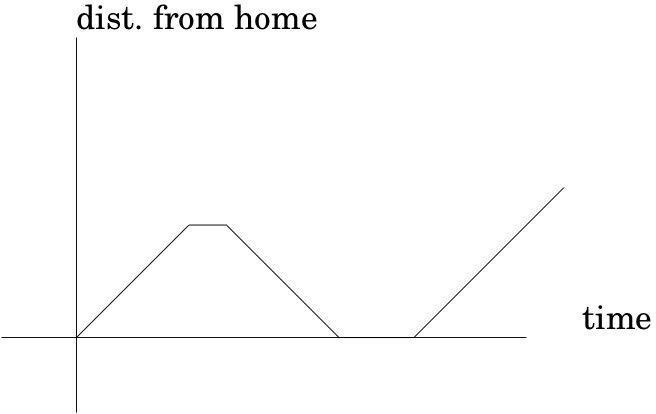
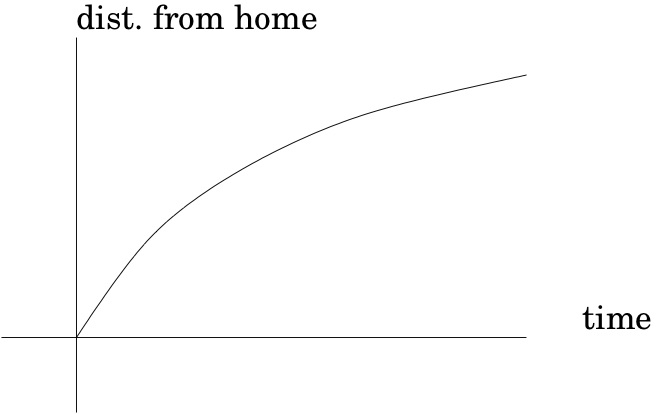
The following Checkpoint is about the following graphs, borrowed from Hughes-Hallet et al.:

Checkpoint 16.

Number the graphs like this:
1 2
3 4
Which of graph best matches each of the following stories?
  1. I had just left home when I realized I had forgotten my books, so I went back to pick them up.
  2. Things went fine until I had a flat tire.
  3. I started out calmly but sped up when I realized I was going to be late.
Answer 1.
\(\text{graph (4)}\)
Answer 2.
\(\text{graph (2)}\)
Answer 3.
\(\text{graph (3)}\)
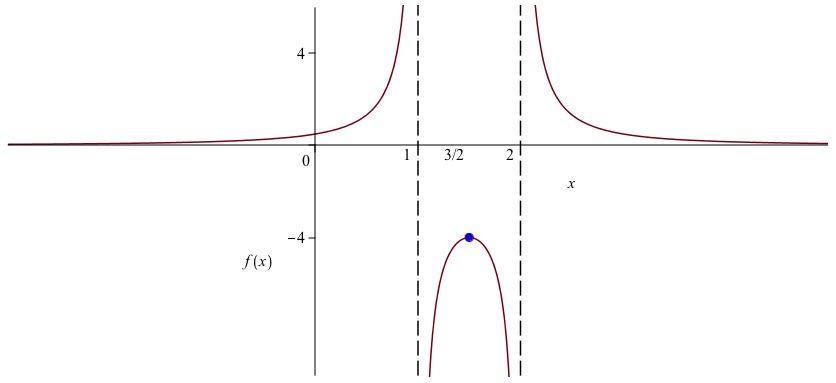
Some conventions make graphs even more effective at conveying information. The axes should be labeled (more on that later) but more importantly, marked so that the scale is clear. Rather than just mark where 1 is on the horizontal and vertical axes, it is often helpful to mark any value where something interesting is going on: a discontuity, an asymptote, a maximum, or a change of cases for functions defined in cases. For example, if we graph \(x \mapsto 1 / (x^2 - 3x + 2)\text{,}\) we should mark vertical asymptotes (a certain kind of discontinuity) on the \(x\)-axis at \(x=1\) and \(x=2\text{;}\) a dashed vertical line is customary. We should mark a local maximum of \(-4\) (marked on the \(y\)-axis) occuring at \(x = 3/2\) (marked on the \(x\)-axis). Another way to do this would be to label and mark the point \((3/2 , -4)\) on the graph. There is a horizontal asymptote at zero, which we would mark with a dashed horizontal line if it occurred anywhere else, but we don’t because it is hidden by the \(x\)-axis. When graphing a function on the entire real line, we can’t go to infinity and stay in scale, so we either go out of scale or draw a finite portion, large enough to give the idea. Choosing the latter, the resulting picture should look something like the graph in Figure 0.11.
Figure 0.11. graph of \(f(x) := 1 / (x^2 - 3x + 2)\)
Here follows a list of tips on graphing an unfamiliar function, call it \(f\text{.}\) The last three tips on shifting and scaling are ones we have found in the past that many students vaguely recall but get wrong, so please make sure you know them.
  1. Is the domain all real numbers? If not, what is it? If the function has a piecewise definition, try drawing each piece separately.
  2. Is there an obvious symmetry? If \(f(-x) = f(x)\) for all \(x\) in the domain, then \(f\) is even and there is a symmetry about the \(y\)-axis. If \(f(-x) = -f(x)\) then \(f\) is odd and there is 180-degree rotational symmetry about the origin.
  3. Are there discontinuities, and if so, where? Are there asymptotes?
  4. Try values of the function near the discontinuities to get an idea of the shape -- these are particularly important places. If the domain includes oints on both sides of a discontinuity be sure to test points on each side.
  5. Try computing some easy points. Often \(f(0)\) or \(f(1)\) is easy to compute. Trig functions are easily evaluated at certain multiples of \(\pi\text{.}\)
  6. Where is \(f\) positive?
  7. Where is \(f\) increasing and where is it decreasing? This will be easier once you know some calculus.
  8. Where is \(f\) concave upward versus concave downward? This will be a lot easier once you know some calculus.
  9. Where are the maxima and minima of \(f\) and what are its values there? This will be a lot easier once you know some calculus.
  10. What does \(f\) do as \(x\) approaches \(\infty\) and \(-\infty\text{?}\)
  11. Is there a function you understand better than \(f\) which is close enough to \(f\) that their graphs look similar?
  12. Is \(f\) periodic? Most combinations of trig functions will be periodic.
  13. Is the graph of \(f\) a shift of a more familiar graph? Graphing \(y = f(x) + c\) shifts the graph up by \(c\text{;}\) this is pretty intuitive; if \(c\) is negative the graph shifts downward. Graphing \(y = f(x+c)\) shifts the graph left or right by \(c\text{.}\) If \(c\) is positive, the graph shifts left.
  14. Is the graph of \(f\) a rescaling of a more familiar graph? The graph \(y = c f(x)\) stretches vertically by a factor of \(c\text{.}\) When \(c \lt 1\) this is a shrink rather than a stretch.
  15. The graph of \(y = f(cx)\) stetches or shrinks in the horizontal direction. When \(c \gt 1\text{,}\) it is a shrink. Why? Try sketching \(y = \cos x\) and on top of this sketch \(y = \cos (2x)\text{.}\)

Checkpoint 17.

In vertical stretching, what happens when \(c\) is negative?
Sketch the specific example where \(c = -2\) and \(f(x) = x^2\) on the domain \([-1,1]\)

Checkpoint 18.

In horizontal stretching and shrinking, explain why \(0\lt c\lt 1\) is stretching and \(1\lt c\) is shrinking.
Does this surprise you?
What happens when \(c\) is negative?