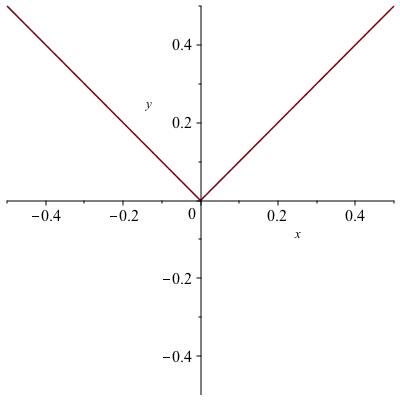
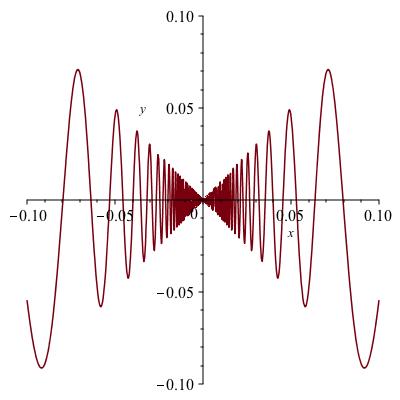
Most functions we use in mathematical modeling have unique tangent lines at most points. The slope of the tangent line to the graph of \(f\) at the point \((x,f(x))\) seems like one reasonable definition of \(f'(x)\text{.}\) In rare cases, such as you have already seen, we can use geometry to prove there is exactly one line tangent to the graph of \(f\) at a point and compute the slope.
Unfortunately, there are not many functions for which the graph is a well known geometric object. In most cases we can’t use geometry to conclude that there is a tangent line, that there is only one tangent line, or what the slope of this line is, if indeed there is exactly one. Keeping this in mind, we will use limits to come up with a definition that works for most functions and, when it does not work, as in the examples in Figure 3.2, gives an indication of why. In cases when it does not work, in fact we would probably agree that there is no good way to make sense of the instantaneous slope.
The graphs of \(|x|\text{,}\)\(x \sin (1/x)\) and \(\sqrt[3]{x}\) are shown in Figure 3.2. All contain the point \((0,0)\) provided we add zero to the domain of the second function and define the function to be zero there. In each case, say whether there is one, none, or more than one tangent line to the graph at \((0,0)\text{.}\)
We can take average slopes over any interval we want. The slope over the interval \([a,b]\) is the slope of the secant line passing through \((a,f(a))\) and \((b,f(b))\text{.}\) This is also called the difference quotient of \(f\) at the arguments \(a\) and \(b\text{.}\) What happens when one endpoint of the interval is \(x\) and the other is very close to \(x\text{?}\) Pictorially, it looks like the slope gets very close to the slope of the tangent line at \((x,f(x))\text{.}\)Figure 3.3 gives a tool for exploring this secant-line-to-tangent-line approximation.
Figure3.3.Secant lines approaching a tangent line. You can input your favorite function and slide \(c\text{,}\) which is where the tangent line is computed. Slide \(a\) and \(b\) to see the secant line. What happens as we move \(a\) and \(b\) closer to \(c\text{?}\)
The derivative is a mathematical definition meant to compute the slope of the tangent line at \(a\text{.}\)Definition 3.4, however, only talks about limits of slopes of secants, not of tangents. Do you think these two notions will always coincide? There isn’t a right answer to this.
if the limit exists, and say that \(f'(a)\) is undefined if the limit does not exist. Because we want to emphasize that \(b-a\) is going to zero, we often define \(h := b-a\) and rewrite the definition as
Suppose a student complains that Figure 3.3 illustrates a limit of the form \(\displaystyle\lim_{b \to a^+}\text{,}\) not \(\displaystyle\lim_{b \to a}\text{.}\) What could you add to the picture to address her concerns?
The first equality is true because we can cancel the factors of \(b-1\) (remember, the limit looks at values of \(b\) near 1 but not equal to 1). The second equality is true because we can evaluate the limit of the polynomial \(b+1\) at \(a=1\) by plugging in 1 for \(b\) (Proposition 2.31).
We already agreed to use a prime after the function name as one way to denote a derivative. Thus the derivative of \(f\) is \(f'\text{,}\) the derivative of \(g\) is \(g'\text{,}\) the derivative of \(\Gamma\) is \(\Gamma'\text{,}\) etc. We may need to refer to the derivative of a function when it has not been given a name. One could imagine something like the notation \((cx)'\) for the derivative of the function "multiply by \(c\)", or perhaps the more precise
To avoid ambiguity, we use the notation \(\frac{df}{dx}\) for the derivative of \(f\)with respect to \(x\text{.}\) This is better than \(f'\)when there is more that one variable that could be differentiated. that one variable that could be differentiated. You can also write this as \(\frac{d}{dx} f\) when \(f\) is a big long cumbersome expression, for example,
\begin{equation*}
\frac{d \left ( \frac{e^{x^2-1} \sin x}{1+x} \right )}{dx} \qquad
\text{ is the same as } \qquad
\frac{d}{dx} \left ( \frac{e^{x^2-1} \sin x}{1+x} \right ) \qquad
\end{equation*}
Then there is the question of how to write \(f'(a)\text{,}\) the value of the function \(f'\) at argument \(a\text{,}\) in this notation. Should we write \(\frac{d\, f(a)}{dx}\) or \(\frac{df}{dx} (a)\text{?}\) The second is better, for example, \(\frac{d(x^3-3x+1)}{dx} (a)\text{,}\) because the first looks like you are differentiating a constant. Another common way of writing this is \(\left. \frac{d \, (x^3 - 3x + 1)}{dx}
\right|_{x=a}\text{.}\)
Suppose the number of feet an object has fallen after \(t\) seconds is given by \(16 t^2 + ct\) where \(c\) is its initial downward velocity (This is in fact true when air resitance is ignored and the earth’s gravitational constant is approximated.). Write an expression for the downward instantaneous speed of the object after \(t\) seconds. Please don’t compute any derivatives, just write an expression in some notation involving a derivative.
Further interpretations: error propagation and marginal effect.
You have seen examples in which derivatives represent speed. More generally, the derivative of a function of time represents the rate of change of the quantity per time. Here are some other things derivatives commonly represent.
Suppose you have a formula \(f(x)\) involving a quantity \(x\) that is measured, but with measurement error. Then \(f'(x)\) tells you how much error you get in \(f\) per amount of error in measuring \(x\text{.}\)
A \(4 \times 8\) foot board is cut parallel to the long side to obtain a \(3 \times 8\) board. The accuracy of the cut is \(1/4\) inch. What is the accuracy of the area, in square feet? Writing \(A = \ell \times w\) and differentiating gives \(dA/dw = \ell =\)8 feet in our case. Therefore, the error in area (in square feet) is 8 feet times the measurement error in the width (in linear feet). Plugging in a measurement error of \(1/4\) inch, which equals \(1/48\) feet, we see the area is accurate to within \(8 \mbox{ ft} \times \frac{1}{48}
\mbox{ ft} = \frac{1}{6} \mbox{ ft}^2 \text{.}\)
Let \(\Delta x\) denote the possible error in \(x\text{,}\) and \(\Delta f\) denote the possible resulting error in \(f(x)\text{.}\) Write a formula relating these quantities and the derivative of \(f\text{.}\)
Another interpretation is the marginal effect of the variable on the function. For example, if \(f(x)\) represents the cost of producing \(x\) barrels of refined oil, then \(f'(x)\) is the marginal cost of production of more oil. Unless \(f\) is linear, this will depend on \(x\text{.}\) The marginal cost of further production usually depends on the present level of production.