Somewhat surprisingly, finding clean formulas for integrals involves derivatives.
Aside
To see how this works, we look at the indefinite integral. Replacing the upper limit on the integral by a variable yields a function of that variable. To say this in another way, we may consider \(\displaystyle\int_a^b f(x) \, dx\) as a function of the free variables \(a\) and \(b\) (it can’t be a function of \(x\) because \(x\) is a bound variable). Let \(a\) remain a constant but consider \(b\) to be a variable. We then have a function, \(b \mapsto \displaystyle\int_a^b f(x) \, dx\text{.}\) Denote this function by \(G\text{,}\) in other words \(G(b) := \displaystyle\int_a^b f(x) \, dx\text{.}\)
Let \(f (x) := 3x\) and \(a = 0\text{.}\) Then \(G(b) := \displaystyle\int_0^b 3x \, dx\text{.}\) Definite integrals compute area, hence \(G(b)\) is the area of the triangle with vertices at the origin, \((b,0)\) and \((b,3b)\text{.}\) The triangle area formula gives \(G(b) = (3/2) b^2\text{.}\)
For fun (we have a warped sense of fun), compute \(G'\text{.}\) That’s an easy one: \(G'(b) = 3b\text{.}\) Note that this is the integrand of the original integral, with the free variable \(b\) in place of the bound variable \(x\text{.}\) This is not a coincidence, as the following theorem asserts.
Let \(f\) be a continuous function on an interval \([a,c]\text{.}\) For \(b \in (a,c)\text{,}\) let \(G(b) := \displaystyle\int_a^b f(x) \, dx\text{.}\) Then \(G'(b)
= f(b)\text{.}\)
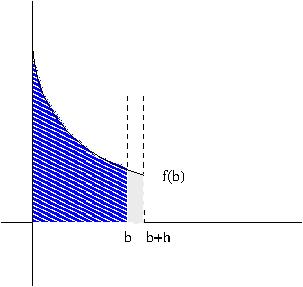
When \(h\) is small, the value of \(G(b+h)\) is very well approximated by \(G(b) + h f(b)\text{;}\) in the picture at the right, \(G(b)\) is the blue area and \(G(b+h)\) is the blue area plus the shaded black and white area. Plugging this in gives \(\frac{G(b) + h f(b) - G(b)}{h} = f(b)\text{.}\) To turn this into a proof, you need to use continuity of \(f\) to show that the error replacing \(G(b+h)\) by \(G(b) + h f(b)\) is \(\ll h\text{,}\) so the approximation does not affect the limit. You already know enough to understand the argument, but in the interest of time, the details are left to a course in mathematical analysis.
The Fundamental Theorem of Calculus says we can evaluate integrals of \(f\) if we know a function \(G\) whose derivative is \(f\text{.}\) That motivates the next definition.
How do we find anti-derivatives? The next chapter is entirely about computing these. Like rules for differentiation, rules for anti-differentiation start from a collection known results. For derivatives, we obtained these from the definition by computing limits. For anti-derivatives, we will get these simply by remembering some basic derivatives. The simple rule yielding the derivative of a polynomial may be run backwards. So for example the monomial \(a x^m\) has anti-derivative \(\frac{a}{m+1} x^{m+1}\text{.}\) We can sum these, obtaining the anti-derivative of any polynomial: an anti-derivative of \(\displaystyle\sum_{k=0}^m a_k x^k\) is given by \(\displaystyle\sum_{k=0}^m \frac{a_k}{k+1} x^{k+1}\text{.}\) In fact this works for negative or fracdtional powers, as long as the power is not \(-1\text{.}\)
We say "an anti-derivative" rather than "the anti-derivative" because for any given \(f\text{,}\) is always more than one anti-derivative. The functions \(G\) and \(G + c\text{,}\) where \(c\) is a constant, have the same derivative, so one is an anti-derivative of \(f\) if the other is. This is the only way anti-derivatives can differ.
Aside
Once you know the value of the anti-derivative at any point, it is easy to reconstruct the correct anti-derivative as an integral, as in the following example.
Suppose \(G\) is an anti-derivative of \(f\) and \(G(3) = 7\text{.}\) We will look for an anti-derivative of the form \(G(b) = c + \displaystyle\int_a^b f(x) \, dx\text{.}\) To write \(G\) as an integral with a variable upper limit, begin by choosing the constant for the lower limit. The most convenient choice is 3, because we are supposed to know the value of \(G\) at 3. The function \(b \mapsto \displaystyle\int_3^b
f(x) \, dx\) is zero at 3, so we will need to add 7. We therefore choose
For concreteness, let’s see how this works with the example from above: \(f(x) = 3x\text{.}\) Then \(G(b) = 7 + \displaystyle\int_3^b 3x \, dx\text{.}\) We already computed \(\displaystyle\int_0^b 3x \, dx = \frac{3}{2} b^2\) and similarly \(\displaystyle\int_0^3 3x \, dx
= (3/2) 3^2 = 27/2\text{.}\) Subtracting, \(\displaystyle\int_3^b 3x \, dx = (3/2) b^2 - 27/2\text{.}\) Thus the anti-derivative we are looking for is \(7 + (3/2) b^2 - 27/2
= (3/2) b^2 - 13/2\text{.}\)
Proposition10.27.computing definite integrals with anti-derivatives.
The definite integral \(\displaystyle\int_a^b f(x) \, dx\) is equal to \(G(b) - G(a)\text{,}\) also denoted \(\left. G \right |_a^b\text{,}\) when \(G\) is any anti-derivative of \(f\text{.}\)
This implies that \(H(b) - H(a)
= G(b) - G(a)\) when \(H\) is any other anti-derivative of \(f\text{.}\) In other words, differences of an anti-derivative at a specified pair of points do not depend on which particular anti-derivative was chosen.