Unit14.2Taylor and Maclaurin polynomials in graphing
We claimed that the Taylor polynomials are polynomials that "act like" the function \(f(x)\) near \(x=c\text{.}\) What does that mean in terms of the graph of \(f(x)\) and its Taylor polynomials?
Figure14.6.Use the checkboxes to display the degrees 1, 2, 3, and 4 Taylor approximations to \(f(x)\text{.}\) You can enter your favorite function \(f(x)\text{,}\) and drag the point \(x=c\) around. Zoom in and out to see how good the approximation is at different scales.
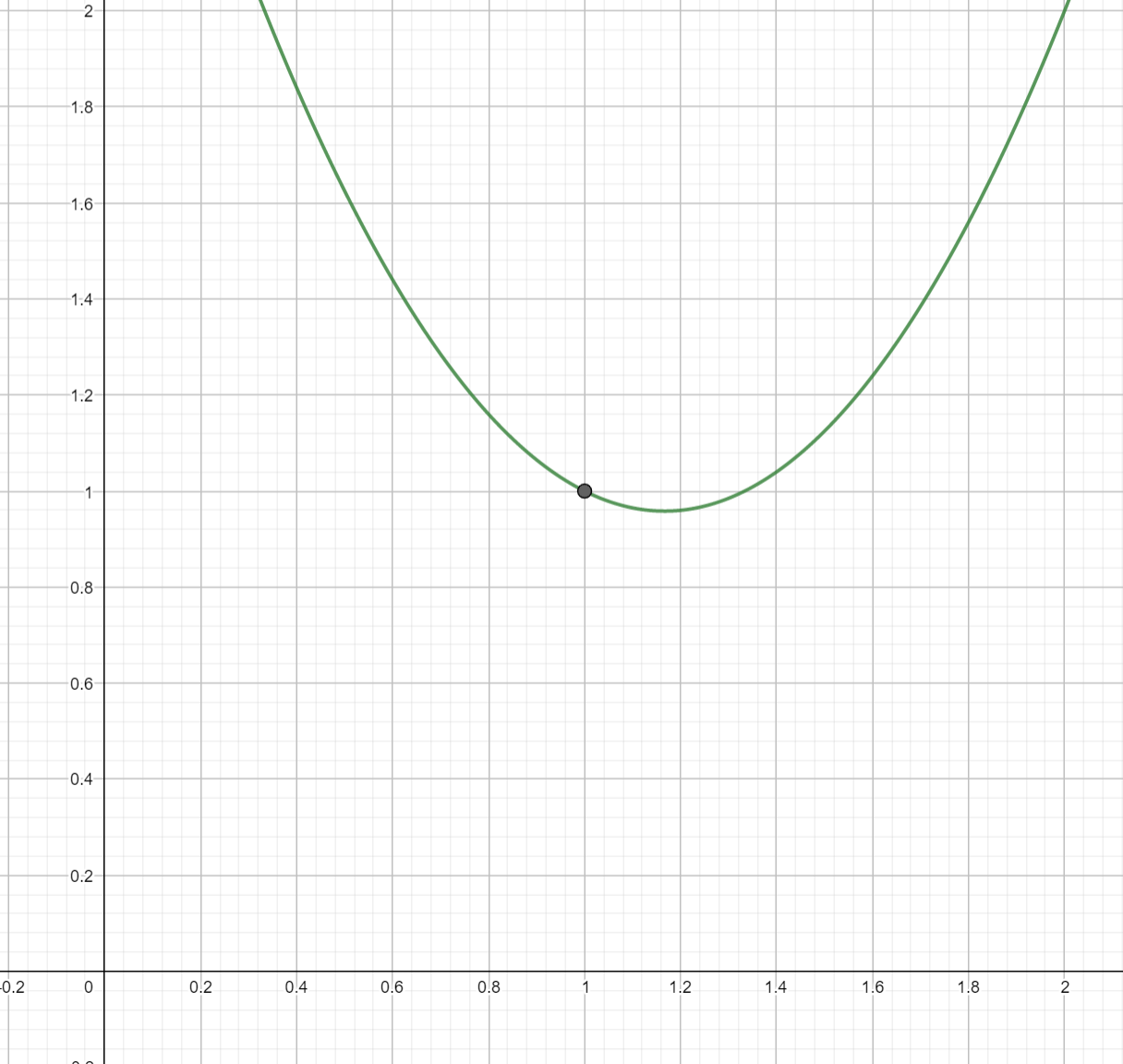
The fact that the graphs of the Taylor polynomials are similar to those of the original function \(f\) gives us a way to explain why the techniques mentioned in Unit 3.3 work. Let’s imagine the situation of a function \(f(x)\) with \(f(1)=1\text{,}\)\(f'(1)=-\frac{1}{2}\text{,}\) and \(f''(1)=3\text{.}\) This is enough information to compute that the degree-2 Taylor polynomial at \(x=1\) is
Figure14.7.Even if we only know that \(f(1)=1\text{,}\)\(f'(1)=-\frac{1}{2}\text{,}\) and \(f''(1)=3\text{,}\) we can plot the degree-2 Taylor approximation to \(f\) and learn about how \(f\) behaves near \(x=1\) (indicated by the gray point).
In particular, we know that any quadratic with a positive coefficient of \(x^2\) has a graph which is an upward-facing parabola. We conclude that \(f\) is concave-up near \(x=1\text{.}\)
This idea also tells us how to graphically interpret higher derivatives: a function with \(f'''(c)>0\) acts like a cubic with positive leading coefficient; one with \(f^{(4)}(c)\lt 0\) acts like a quartic with a negative leading coefficient; etc.
The first approach might be to compute some values of cosine near \(x=0\text{,}\) say \(\cos(-.1)\text{,}\)\(\cos(-.2)\text{,}\)\(\cos(.1)\text{,}\) etc. But those are hard to do by hand! So instead, we’ll use a function we know how to compute the values of by hand: the Maclaurin polynomial of degree 2. That’s
In the example above, we used the degree-2 Maclaurin polynomial for \(f(x)=\cos(x)\text{.}\) Compute the degree-6 Maclaurin polynomial for \(f(x)=\cos(x)\text{.}\)