Unit 2.1 Definitions of limit

You should learn to understand limits in four ways:
Intuitive
The limit as \(x \to a \) of \(f(x) \) is the numerical value (if any) that \(f(x) \) gets close to when \(x \) gets close to (but does not equal) \(a \text{.}\) This is denoted \(\displaystyle\lim_{x \to a} f(x) \text{.}\) If we only let \(x \) approach \(a \) from one side, say from the right, we get the one-sided limit \(\displaystyle\lim_{x \to a^+} f(x) \text{.}\)
Please observe the syntax: If I tell you a function \(f \) and a value \(a \) then the expression \(\displaystyle\lim_{x \to a} f(x) \) takes on a numerical value or "undefined". The variable \(x \) is a bound variable; it does not have a value in the expression and does not appear in the answer; it stands for a continuum of possible values approaching \(a \text{.}\) The variable \(a \) is free and does show up in the answer; for example \(\displaystyle\lim_{x \to a} x^2 \) is equal to \(a^2 \text{.}\)
Pictorial
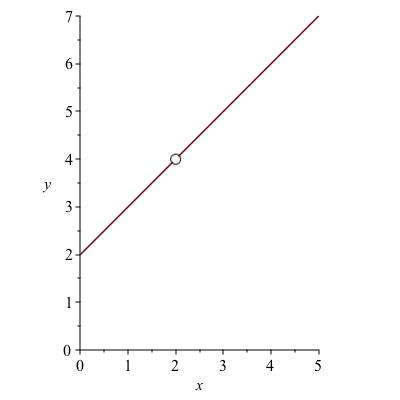
If the graph of \(f \) appears to zero in on a point \((a , b) \) as the \(x\)-coordinate gets closer to \(a \text{,}\) then \(b \) is the limit, even if the actual point \((a,b) \) is not on the graph. For example, suppose \(f(x) = \frac{x^2-4}{x-2} \text{.}\) Canceling the factor of \(x-2 \) from top and bottom, you can see this is equal to \(x+2 \text{,}\) except when \(x=2 \) because then you get zero divided by zero. Functions like this are not just made up for this problem. They occur naturally when solving simple differential equations, where indeed something different might happen if \(x=2 \text{.}\)
The graph of \(f \) has a hole in it, which we usually depict as an open circle, as in the left side of Figure 2.1. The value of \(\displaystyle\lim_{x \to 2} f(x) \) is 2, even though \(f\) is undefined precisely at 2.
In this example the function \(f \) behaved very nicely everywhere except 2, growing steadily at a linear rate. Figure 2.2 shows the somewhat less well behaved function \(g(x) := x \sin(1/x) \text{.}\) This function is undefined at zero. As \(x \) approaches zero, the function wiggles back and forth an infinite number of times, but the wiggles are smaller and smaller. Intuitively, the value of the function \(g \) seems to approach zero as \(x \) approaches zero. Pictorially we see this too: zooming in on \(x=0 \) in the right-hand figure, corroborates that \(g(x) \) approaches zero.
We can take limits at infinity as well as at a finite number. The limit as \(x \to \infty \) is particularly easy visually: if \(f(x) \) gets close to a number \(C \) as \(x \to \infty\) then \(f \) will have a horizontal asymptote at height \(C \text{.}\) Thus \(3 + \frac{1}{x} \text{,}\) \(3+e^{-x}\) and \(3 + \frac{\sin x}{x} \) all have limit 3 as \(x \to \infty \text{,}\) as shown in Figure 2.3.
Formal
The precise definition of a limit is a little unexpected if you’ve never seen it before. We don’t define the value of \(\displaystyle\lim_{x \to a} f(x) \text{.}\) Instead, we define when the statement \(\displaystyle\lim_{x \to a} f(x) = L \) is true. It can be true for at most one value \(L \text{.}\) If there is such a \(L \text{,}\) we call this the limit. If there is no \(L \text{,}\) we say the limit does not exist. When asked for the value of \(\displaystyle\lim_{x \to a} f(x) \text{,}\) you should answer with either a real number, or "DNE", for "does not exist". We won’t have to spend a lot of time on the formal definition. You should see and grasp it at least once. Use of the Greek letters \(\varepsilon \) and \(\delta \) for the bound variables is a strong tradition.
Computational
We’ll focus a lot on how to compute limits, given a formula for a function or some other information about it. This involves rules which allow us to express a complicated limit in terms of several more straightforward limits.
Figure 2.1. Left: \(f(x) = x+2 \) except that \(f \) is undefined at \(x=2 \text{;}\)
Figure 2.2. A "wiggly" function which has a limit at \(x=0\text{.}\) Zoom in and out to explore it.
Figure 2.3. Three functions all having limiting value 3 as \(x \to +\infty\text{.}\)

Definition 2.4.

If \(f \) is a function whose domain includes an interval containing the real number \(a \text{,}\) we say that \(\displaystyle\lim_{x \to a} f(x) = L\) if and only if the following statement is true.
For any positive real number \(\varepsilon \) there is a corresponding positive real \(\delta \) such that for any \(x \) other than \(a \) in the interval \((a-\delta , a+\delta) \text{,}\) \(f(x) \) is guaranteed to be in the interval \((L - \varepsilon , L + \varepsilon) \text{.}\)
In symbols, the logical implication that must hold is:
\begin{equation*} 0 \lt \left\lvert x - a\right\rvert \lt \delta \Longrightarrow \left\lvert f(x) - L\right\rvert \lt \varepsilon \, . \end{equation*}

Remark 2.5.

Loosely speaking, you can think of \(\varepsilon \) as an acceptable error tolerance in the \(y\) value and \(\delta \) as the precision with which you control the input (i.e., the \(x\) value). The limit statement says, you can meet even the pickiest error tolerance provided you can tune the input precisely enough.
Why is this a difficult definition? Chiefly because of the quantifiers. The logical form of the condition that must hold is: For all \(\varepsilon \gt 0 \) there exists \(\delta \gt 0 \) such that for all \(x \in (a-\delta , a+\delta) \text{,}\) \(\cdots \text{.}\) This has three alternating quantifiers (for all... there exists... such that for all...) as well as an if-then statement after all this. Experience shows that most people can easily grasp one quantifier "for all" or "there exists", but that two is tricky: "for all \(\varepsilon \) there exists a \(\delta \ldots\)". A three quantifier statement usually takes mathematical training -- and very careful focus -- to unravel.
Some people find it easier to conceive of the formal definition as a game. Alice is trying to show it’s true. Bob is trying to show it’s false. Alice says to Bob, no matter what \(\varepsilon \) you give me, I can find a \(\delta\) to make the implication true. (The implication is that all \(x\)-values fitting into Alice’s \(\delta\)-interval will give values of \(f(x) \) inside Bob’s interval.) Now they play the game: Bob tries to come up with a value of \(\varepsilon \) so small as to thwart Alice. Then Alice has to say her \(\delta \text{.}\) If she can always do so (assuming Bob has not made a blunder in overlooking the right choice of \(\varepsilon\)) she wins and the limit is \(L \text{.}\) If not (unless Alice has overlooked a \(\delta \) that would have worked), Bob has won and the limit is not \(L \text{.}\) If they can’t agree whether Alice’s \(\delta\) works, they settle it in a similar manner. Bob must find an \(x \in (a-\delta , a+\delta)\) for which \(\left\lvert f(x) – L\right\rvert \geq\varepsilon\text{,}\) or else concede that Alice did her job.
