Basic Ground Rules:
Final grade based on six equal parts: Final exam (equals two parts), three
midterm exams,
everything else. Everything else includes regular homework, computer
homework, the occasional quiz in recitation, lecture points, etc..
Homework will be
assigned on Thursdays, and will
be due at Thursday's lecture the following week.
You will almost always need to use the computer to do some
of your homework.
Homework will contain instructions for reading. Make sure you do the
reading before the class for which it is assigned. I will assume you
have done so.
Make use of my office hours, Math Center, Maple Center,
Electronic newsgroups (upenn.math.math104), Sunday Night Reviews
(Sundays from 7-9 p.m. in DRL A1) etc..
Grading notes: At the end of the semester, everyone who has not withdrawn from the
class will get a grade. Incompletes will not be given to avoid F's.
Exams:
- First midterm: Wednesday, February 4 at 6:30pm in Logan 17
- Second midterm: Wednesday, March 3 at 6:30pm in Chem 102
- Third midterm: Wednesday, April 14 at 6:30pm in DRL A1 and A2
- Final exam: Thursday, May 6 from 11:00am - 1:00pm
Ways to get help:
- Sunday night reviews (beginning 7-9 pm in DRL
A1)
- Math and Maple Centers
- The Tutoring Center -
check out
their (free!) "Satellite Centers", Math 104 Workshops
(run by Ronica Licciardello)
beginning on Monday, January 26 (They will run on Monday and Wednesday
evenings from 7:00-8:30 pm in DRL 3N6),
and one-on-one
tutoring.
Class notes:
Homework and class notes:
- Week 1 (with homework assignment #1 and bonus
problem #1)
- Week 2 (with homework assignment #2 and
bonus problem #2)
- Week 3 (with homework assignment #3 and bonus
problem #3)
- Week 4 (with homework assignment #4 and bonus
problem #4)
- Week 5 (with homework assignment #5 and bonus
problem #5)
- Week 6 (with homework assignment #6 and bonus
problem #6) Now due March 4! with
additional
problems #3, 10, 15, 22, 34, 42, 47, 50, 62, and 74 from
this page.
- Week 7 (with homework assignment #7 and bonus
problem #7)
- Week 8 (with homework assignment #8 and bonus
problem #8)
- Still more integrals to practice on! Page 1, Page 2.
- Week 9 (with homework assignment #9 and bonus
problem #9)
- Week 10 (with homework assignment #10 and
bonus problem #10)
Bonus problems and solutions:
- Bonus problem #1: Suppose that three points on the parabola
y = x2 have the property that their normal lines
intersect at a common point. Show that the sum of their
x-coordinates is 0. Is this if and only if?
Bonus problem #2: Consider a square with side length
L. Let R be the region inside the square
consisiting of all points that are closer to the center of the
square than to any side of the square. What is the area of
R?
Bonus problem #3: This is a classic but difficult
problem.
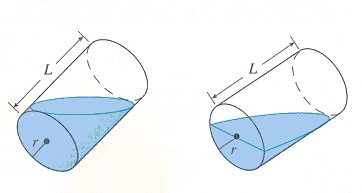
A cylindrical glass of radius r and height L is
filled
with water and then tilted until the water remaining in the glass exactly
covers its base (as in the picture on the left below).
(a) Determine a way to "slice" the water into parallel rectangular
cross sections and then set up a definite integral for the
volume of the water in the glass.
(b) Determine a way to "slice" the water into parallel cross-sections
that are trapezoids and then set up a definite integral for the
volume of the water.
(c) Find the volume of water in the glass by evaluating one of the
integrals in part (a) or part (b).
(d) Find the volume of water in the glass from purely geometric
considerations.
(e) Suppose the glass is tilted until the water covers half the base,
as in the picture on the right below.
In what direction can you "slice" the water into triangular cross
sections?
Rectangular cross-sections? Cross-sections that are segments of circles?
Find the volume of water in the glass.
Here are two pictures that may help:
Bonus problem #4:
Evaluate
 Bonus problem #5:
Evaluate:
Bonus problem #5:
Evaluate:
 Bonus problem #6:
This problem gives you an opportunity to calculate the escape velocity of
a rocket leaving the earth. It is an interesting combination of some
physics, the idea of differential equations, and limits. Let's work this
one together this week!According to Newton's Law of Universal
Gravitation, the gravitational force on an object of mass mthat
has been projected vertically upward from the earth's surface is
Bonus problem #6:
This problem gives you an opportunity to calculate the escape velocity of
a rocket leaving the earth. It is an interesting combination of some
physics, the idea of differential equations, and limits. Let's work this
one together this week!According to Newton's Law of Universal
Gravitation, the gravitational force on an object of mass mthat
has been projected vertically upward from the earth's surface is  where x=x(t) is the object's distance
above the sruface at time t, R is the radius of the earth,
andg is the acceleration due to gravity at the surface of the
earth. Also, by Newton's Second Law (the F=ma one),
where x=x(t) is the object's distance
above the sruface at time t, R is the radius of the earth,
andg is the acceleration due to gravity at the surface of the
earth. Also, by Newton's Second Law (the F=ma one),
 .
.
(a) Suppose a rocket is fired vertically upward with an initial
velocity ![v[0]](images/escvel3.gif) . Let hbe the maximum height above the surface
reached by the object. Show that
. Let hbe the maximum height above the surface
reached by the object. Show that
![v[0] = sqrt(2*g*R*h/(R+h))](images/escvel4.gif) .
.
(Hint: By the Chain Rule,  . )
. )
(b) Calculate ![v[e] = limit(v[0],h = infinity)](images/escvel6.gif) . This limit is called the escape velocityfor the
earth.
. This limit is called the escape velocityfor the
earth.
(c) Use R = 3960 miles and g = 32 ft/  to calculate
 ![v[e]](images/escvel8.gif) in feet per second and in miles per second.
in feet per second and in miles per second.
Bonus problem #7:
A dog sees a rabbit running in a straight line across an open field and
gives chase. In a rectangular coordinate system, assume:
(i) The rabbit is at the origin and the dog is at the point (L,0) at
the instant the dog first sees the rabbit.
(ii) The rabbit runs up the y-axis and the dog always runs
straight for the rabbit.
(iii) The dog runs at the same speed as the rabbit.
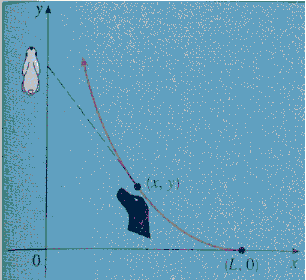
(a) Explain why the dog's path is the graph of the function
y = f(x), where y satisfies the
differential equation:

(b) Determine the solution of the equation in part (a) that
satisfies the initial conditions y = y' = 0 when x = L.
(Hint: Let z = dy/dx in the differential equation
and solve the resulting first-order equation to find z. Then
integrate z to find y.)
(c) Does the dog ever catch the rabbit?
(d) What if you replace hypothesis (iii) by
(iii)' The dog runs twice as fast as the
rabbit.
You have to adjust the differential equation for the path of
the dog (put a "2" in the right place). Do this, and solve the
differential equation. At what point does the dog catch the rabbit?
(Hint: So you know the slope of the dog's path (it's along the line
from wherever the dog is to wherever the rabbit is), and you know the dog
and the rabbit traverse the same distance (i.e., arclength) in the same
amount of time. How do these observations help you to construct the
differential equation?)
Bonus problem #8:
A two-parter:
(a) Show that tan (x/2) = cot(x/2) - 2 cot(x)
(b) Find the sum of the series:


Part (a) looks like a trig identity...can you prove it? How can you use it
to prove part (b) ?
Bonus problem #9:
Another two-parter:
(a) Find the sum of the series

where the terms are the reciprocals of the positive integers whose
only
prime factors are 2s and 3s.
(b) Consider the series whose terms are the reciprocals of the
positive
integers that can be written in base-10 notation without using the digit
0.
Show that this series is convergent and that its sum is less than 90.
Bonus problem #10:
(a) Show that for  ,
,

if the left side lies between  and
and  .
.
(b) Show that

(c) Deduce the following formula of John Machin (1680-1751):

(d) Use the Maclaurin series for arctan to show that arctan(1/5) is
between 0.197395559 and 0.197395562.
(e) Show that arctan(1/239) is between 0.004184075 and
0.004184077.
(f) Deduce that, correct to seven decimal places,  is 3.1415927.
Machin used this method in 1706 to find
correct to 100 decimal places. (Of course, by now, with computers, has been calculated to more than a billion decimal
places.)
Maple worksheets from class:
Solutions to homework and in-class problems