CHAPTER 13 - Multiple Integrals
Section 13.1, page 1010
Problem 33
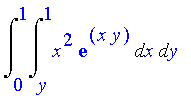
The problem is
| > | Int(Int(x^2*exp(x*y),x=y..1),y=0..1); |
Maple can do this:
| > | value(%); |

But let's sketch the region of integration ("for every y between 0 and 1, x goes from the line x=y to the line x=1").
| > | plot({[y,y,y=0..1],[1,y,y=0..1]},color=blue,thickness=2); |
![[Maple Plot]](images/m114-ex133.gif)
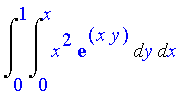
Another way to describe this triangle is "for every x from 0 to 1, y goes from the line y=0 to the line y=x", and so our integral is equivalent to:
| > | Int(Int(x^2*exp(x*y),y=0..x),x=0..1); |
| > | value(%); |

Problem 68
To get Maple to evaluate integrals numerically:
| > | evalf(Int(Int(exp(-x^2-y^2),x=0..1),y=0..1)); |

Section 13.3, page 1024
Problem 35
First let's plot the base - inside the cardioid and outside the circle:
| > | r1:=1; r2:=1+cos(t); |


| > | plot({[r1*cos(t),r1*sin(t),t=0..2*Pi],[r2*cos(t),r2*sin(t),t=0..2*Pi]},color=blue,thickness=2,scaling=constrained); |
![[Maple Plot]](images/m114-ex139.gif)
We can see that t goes from  to
to  . The height over any point is equal to x=r cos(t). So we can calculate the volume:
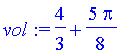
| > | vol:=int(int(r*cos(t)*r,r=r1..r2),t=-Pi/2..Pi/2); |
Problem 44
The curves are y=0 (that's just  ), y=x/2 (that's
 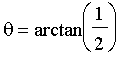 ), and x=1 (that's
 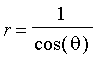 ). The domain is a triangle, we don't really need to plot it, right?
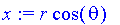
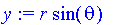
To do the integral in polar, set:
| > | x:=r*cos(theta); y:=r*sin(theta); |
| > | Int(Int(simplify(x/(x^2+y^2)*r),r=0..1/cos(theta)),theta=0..arctan(1/2)); |
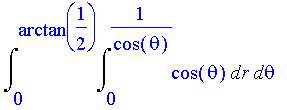
| > | value(%); |

Not so bad.
Section 13.6, page 1044
Problem 40
The region looks like an ice-cream cone:
| > | restart; |
| > | with(plots,display3d): |
| > | A:=plot3d([rho*sin(Pi/4)*cos(theta),rho*sin(Pi/4)*sin(theta),rho*cos(Pi/4)],rho=0..3,theta=0..2*Pi): |
| > | B:=plot3d([3*sin(phi)*cos(theta),3*sin(phi)*sin(theta),3*cos(phi)],phi=0..Pi/4,theta=0..2*Pi): |
| > | display3d({A,B},scaling=constrained); |
![[Maple Plot]](images/m114-ex1320.gif)
Now we can find the volume easily in spherical coordinates:
| > | vol1:=int(int(int(rho^2*sin(phi),rho=0..3),phi=0..Pi/4),theta=0..2*Pi); |

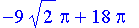
Or in cylindrical coordinates, the cone is r=z and the sphere is 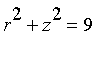 . So the volume is
| > | int(int(int(r,z=r..sqrt(9-r^2)),r=0..3*sqrt(2)/2),theta=0..2*Pi); |
How about that!