![[Maple Plot]](images/m114-ex121.gif)
CHAPTER 12 - Multivariable Functions and Partial Derivatives
Section 12.1, page 914
Problem 5
The domain of the function xy is all pairs of real numbers, so we'll just draw the level curves.
| > | with(plots,contourplot): |
| > | contourplot(x*y,x=-4..4,y=-4..4,contours=[-10,-8,-6,-4,-2,0,2,4,6,8,10],color=blue,thickness=2); |
Here's the actual surface, with the contours on it:
| > | plot3d(x*y,x=-4..4,y=-4..4,style=patchcontour); |
![[Maple Plot]](images/m114-ex122.gif)
(see the Math 104 solved problems for more from this section)
Section 12.2, page 921
Problem 16
We'll do what it says -- simplify first, then take the limit:
| > | simplify((y+4)/(x^2*y-x*y+4*x^2-4*x)); |

Clearly this expression is ok as x approaches 2 and y approaches -4:
| > | subs(x=2,y=-4,%); |

This is the limit.
Problem 35
We'll show that taking the limit in x first then y is different from y first then x:
| > | f:=-x/sqrt(x^2+y^2); |
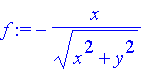
| > | limit(limit(f,x=0),y=0); |

| > | limit(limit(f,y=0),x=0); |

| > | limit(limit(f,y=0),x=0,right); |

(see the Math 104 solved problems for more from this section)
Section 12.3, page 931
Problem 57
If we're going to find  then we must be thinking of z as a function of x and y:
| > | eqn:=x*y+z(x,y)^3*x-2*y*z(x,y)=0; |

| > | solve(diff(eqn,x),diff(z(x,y),x)); |
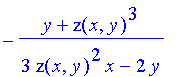
and at (1,1,1):
| > | subs(x=1,y=1,z(1,1)=1,%); |

| > | restart; |
Problem 65
| > | f:=exp(-2*y)*cos(2*x); |
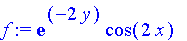
| > | simplify(diff(f,x$2)+diff(f,y$2)+diff(f,z$2)); |

(see the Math 104 solved problems for more from this section)
Section 12.4, page 942
Problem 20
We'll be thinking of R as a function of R1 and R2:
| > | eqn:=1/R(R1,R2)=1/R1+1/R2; |
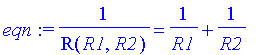
| > | Rx:=solve(diff(eqn,R1),diff(R(R1,R2),R1)); |
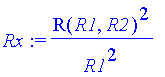
| > | Ry:=solve(diff(eqn,R2),diff(R(R1,R2),R2)); |
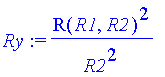
| > | dR:=Rx*dR1+Ry*dR2; |
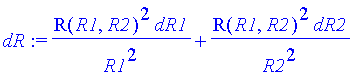
This is part (a). For part (b), we have numbers:
| > | solve(subs(R1=100,R2=400,eqn),R(100,400)); |

| > | subs(R1=100,R2=400,R(100,400)=80,dR); |
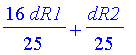
So the resistance R is more sensitive to variations in R1, because the derivative of R with respect to R1 is bigger.
Section 12.5, page 950
Problem 40
We'll write expressions for volume, surface area and diagonal in terms of a(t), b(t) and c(t):
| > | vol:=a(t)*b(t)*c(t); surf:=2*a(t)*b(t)+2*a(t)*c(t)+2*b(t)*c(t); diag:=sqrt(a(t)^2+b(t)^2+c(t)^2); |



| > | subs(diff(a(t),t)=1,diff(b(t),t)=1,diff(c(t),t)=-3,a(t)=1,b(t)=2,c(t)=3,diff(vol,t)); |

Volume is increasing at 3 cubic meters per second
| > | subs(diff(a(t),t)=1,diff(b(t),t)=1,diff(c(t),t)=-3,a(t)=1,b(t)=2,c(t)=3,diff(surf,t)); |

Surface area isn't changing at that particular moment.
| > | subs(diff(a(t),t)=1,diff(b(t),t)=1,diff(c(t),t)=-3,a(t)=1,b(t)=2,c(t)=3,diff(diag,t)); |

So the diagonals are getting smaller.
Section 12.7, page 967
Problem 18
| > | f:=x^2*y+exp(x*y)*sin(y); |

| > | simplify(subs(x=1,y=0,[diff(f,x),diff(f,y)])); |
![[0, 2]](images/m114-ex1228.gif)
OK - so the direction of fastest increase at this point is just in the y-direction. And the (directional) derivative in this direction is just the partial with respect to y:
| > | simplify(subs(x=1,y=0,diff(f,y))); |

Problem 31
| > | eqn:=cos(Pi*x)-x^2*y+exp(x*z)+y*z=4; |

The normal vector is just the gradient of the left side:
| > | nvec:=simplify(subs(x=0,y=1,z=2,[diff(lhs(eqn),x),diff(lhs(eqn),y),diff(lhs(eqn),z)])); |
![nvec := [2, 2, 1]](images/m114-ex1231.gif)
So the equation of the tangent plane is:
| > | 2*x+2*y+z=subs(x=0,y=1,z=2,2*x+2*y+z); |

And parametric equations for the normal line are:
| > | x=0+2*t, y=1+2*t, z=2+t; |

Section 12.8, page 975
Problem 36
First we look for interior critical points:
| > | T:=48*x*y-32*x^3-24*y^2; |

| > | crits:=solve({diff(T,x)=0,diff(T,y)=0},{x,y}); |

Only the second one is in the interior, so we only remember that one for later.
Now for the four edges. First, the y=0 edge:
| > | crits1:=solve(diff(subs(y=0,T),x)=0,x); |

The origin is not in the interior of the edge, so we move on to the x=1 edge:
| > | crits2:=solve(diff(subs(x=1,T),y)=0,y); |

The point (1,1) is not in the interior of the edge (it's on a corner), so we move on to the y=1 edge:
| > | crits3:=solve(diff(subs(y=1,T),x)=0,x); |
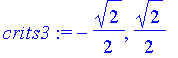
The second of these will have to be checked (i.e., the point ![[sqrt(2)/2, 1]](images/m114-ex1239.gif) ). Finally:
). Finally:
| > | crits4:=solve(diff(subs(x=0,T),y)=0,y); |

OK - we only have one interior point, one edge point and the four corners to check:
| > | subs(crits[2],T); |

| > | subs(x=crits3[2],y=1,T); |

| > | evalf(%); |

| > | subs(x=0,y=0,T); |

| > | subs(x=0,y=1,T); |

| > | subs(x=1,y=1,T); |

| > | subs(x=1,y=0,T); |

We conclude that the absolute max occurs at the interior critical point [1/2,1/2], and the absolute min occurs at the corner [1,0]. We plot to make sure:
| > | plot3d(T,x=0..1,y=0..1,style=patchcontour); |
![[Maple Plot]](images/m114-ex1248.gif)
Looks like we got it right.
Problem 42
| > | f:=x*y+2*x-ln(x^2*y); |

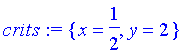
| > | crits:=solve({diff(f,x)=0,diff(f,y)=0},{x,y}); |
| > | H:=diff(f,x$2)*diff(f,y$2)-diff(f,x,y)^2; |
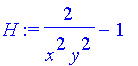
| > | subs(crits,H); |

| > | subs(crits,diff(x$2)); |

Since the discriminant is positive and the second derivative with respect to x is positive, the function has a local minimum at (1/2,2). Also note that when x and y approach zero, the log of  goes to
  , so the function f goes to +
 . And as x and y grow the function also gets big. So our point must be the global min.
Section 12.9, page 987
Problem 46
| > | f:=x*y*z; g1:=x^2+y^2-1; g2:=x-z; |

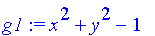

| > | F:=f-lambda*g1-mu*g2; |

| > | crits:=solve({diff(F,x)=0,diff(F,y)=0,diff(F,z)=0,diff(F,lambda)=0,diff(F,mu)=0},{x,y,z,mu,lambda}); |



| > | subs(crits[1],f); |

| > | subs(crits[2],f); |

| > | c3:=allvalues(crits[3]); |




| > | subs(c3[1],[f,g1,g2]); |
![[2/9*3^(1/2), 0, 0]](images/m114-ex1270.gif)
| > | subs(c3[2],[f,g1,g2]); |
![[-2/9*3^(1/2), 0, 0]](images/m114-ex1271.gif)
| > | subs(c3[3],[f,g1,g2]); |
![[2/9*3^(1/2), 0, 0]](images/m114-ex1272.gif)
| > | subs(c3[4],[f,g1,g2]); |
![[-2/9*3^(1/2), 0, 0]](images/m114-ex1273.gif)
So the max and min of our function are + and -  , and these occur at [
 ,
, ,
, ] and points obtained by negating y or both x and z (independently, so there are 4 choices).