CHAPTER 5 - Applications of Integrals
Section 5.1, page 371
Problem 31
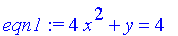
First, we'll plot the region of interest. Since the equations are easily solved for y, we'll do that first:
| > | eqn1:=4*x^2+y=4; eqn2:=x^4-y=1; |
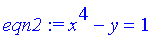
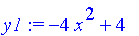
| > | y1:=solve(eqn1,y); y2:=solve(eqn2,y); |
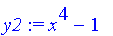
And we'll solve for where the curves cross so we know where to plot:
| > | solve({eqn1,eqn2},{x,y}); |

The third thing is complex, so looks like x should go from -1 to 1. We'll go a little farther, just in case:
| > | plot({y1,y2},x=-2..2,color=blue,thickness=2); |
![[Maple Plot]](images/m103ex-56.gif)
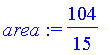
Now we're ready to calculate the area. y1 is on top since it's the parabola that opens down:
| > | area:=int(y1-y2,x=-1..1); |
Section 5.3, page 385
Problem 9
First we'll graph the region and the solid:
| > | with(plots,tubeplot): |
| > | plot(sqrt(cos(x)),x=0..Pi/2,color=blue,thickness=2); |
![[Maple Plot]](images/m103ex-58.gif)
| > | tubeplot([x,0,0],x=0..Pi/2,radius=sqrt(cos(x))); |
![[Maple Plot]](images/m103ex-59.gif)
To calculate the volume, we just integrate  from 0 to
  :
:
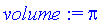
| > | volume:=int(Pi*(sqrt(cos(x))^2),x=0..Pi/2); |